Minggu, 18 Oktober 2009

Denim Jeans - Fashion History

.

Where did the name Denim Jeans come from?

'Serge de Nîmes'

In fashion history, jeans and denim history continues to baffle us. No one truly knows the perfect answer to where jeans began. As so often happens fashions often emerge together in various parts of the world and are the result of the sudden availability of a new fabric, cloth, dye or technique.

But we do know that the phrase denim jeans is thought to derive from several sources. The majority of source books suggest that denim derives from the English translation of the South of France French phrase 'Serge de Nîmes'. Denim fashion history is thus associated with Serge de Nîmes.

It may well be that the fabric which was made in France also had a version made locally in England, and was called by the same name of denim, in the same way that Cheddar cheese is called cheddar all over the world. The Serge de Nîmes was originally a wool silk mix, twill weave. Certainly by the 19th century in England, denim had a white warp and a navy woof (weft). Denim was considered a hard wearing sturdy fabric, ideal for heavy labouring.

Genoese

It is also thought the name ' jeans ' comes from 'Genoese' the name for Italian sailors of Genoa who when at sea dressed in blue fustian fabric, composed of a cotton and wool or linen blend. Genoese fabric was imported into Britain as far back as the 16th century.

Thomas Hardy used the word fustian to describe basic clothes of a skilled countryman in 'The Mayor Of Casterbridge'. He mentions a fustian waistcoat, breeches and a jacket, all the type of garments often made up in jeans material today. In Pickwick Papers, fustian is described by Dickens as 'common fustian' which firmly puts it in the everyday category.

In the 19th century, American weavers made hard wearing cotton duck, denim and jeans fabrics to satisfy a home market. At some time, some manufacturers must have replaced the yarns with the locally produced, more readily available cotton making the fabrics all cotton.

»

Levi Strauss the Inventor of Trousers called Denim Jeans

Jeans history would be nothing without Levi Strauss. Levi Strauss is credited with inventing jeans. Levi Strauss emigrated with his family to New York in 1847. His family sold dry goods such as canvas tenting and Manchester drapery goods. He moved to San Francisco in the early 1850s because he thought the same dry goods business would be brisk, because of the California gold rush.

About 20 years later, a solvent Levi Strauss and a Nevada tailor joined forces to patent an idea the tailor had for putting rivets on stress points of workman's waist high overalls, commonly known as jeans. Levi Strauss chose to use the stronger denim fabric and cotton duck, putting his own name on the product. Later the duck fabric was dropped as consumers found denim more comfortable, particularly after washing. Washing creates the faded bloom on the indigo blue dyeing that we all love.

Eventually in the 1950s people asked for denim jeans or just as often - Levi's jeans, rather than waist overalls. Other manufacturers began to produce jeans. Other brand names such as Lee Coopers and Wranglers also became famous. Each brand is renowned for having a particular cut.

Film Stars Influence Denim Jeans in the 1950s

Jeans fashion history was truly made in the 1950s when film stars wore it in movies that the teenagers of the day followed with avid interest.

For many years jeans were only used as work wear clothes, but by the 1940s they were considered leisure wear in America. Picture of Marlon Brando in jeans and leather jacket.

Once pop and film stars like Elvis Presley, James Dean, and Marlon Brando sported them, they became desirable internationally in the 1950s and are associated with rock and roll and pop music. Later in the 1960s, jean brands old and new were worn universally in the western world.

Left - Marlon Brando screen idol in jeans in the 1950s.

1970's Flower Power and Jeans

In the 1970s, individuals began to really personalize flared bell bottom versions of jeans and added bells up the sides of flared leg styles. Floral and abstract textural embroidery, metal eyelets and studs, transfers, appliqué and even anti-war graffiti biro writing were all popular forms of decoration. Jeans were a great hit with flower people and the hippie revolution. Jeans were the only uniform to wear to a 1970's pop concert.
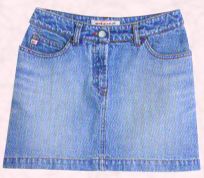
Picture of a denim mini skirt.Jeans never seemed to die, as individuals would cut off the legs to make Bermuda shorts, then short shorts or even duffle bags using a cord to draw up the waist loops. Old jeans got recycled into patchwork jeans and skirts. Right - Denim mini skirt

Levi 501s

The most famous jeans are still probably those produced by Levi as Levi 501s. Pre shrunk jeans had been introduced in the 1960s. 501s traditional button fly jeans designed in the Victorian era need to be shrunk to fit. They were a huge hit again in the 1980s when reintroduced to a new generation.

In a 1980's television advertisement Nick Kamen removed his jeans and stripped to his underpants at a launderette. He proceeded to launder the jeans making them 'shrink to fit' to the music of Marvin Gaye's 'I heard it through the grapevine'. Kamen helped make jeans into a new fashion item for a new generation with the clear link to sexual allure.

±

Designer Jeans

By the 1980s, ripped, frayed and torn jeans were a normal sight. Coloured jeans from white through to pastels were also popular as were stonewashed blue jeans. In the 80s, designer jeans with names like Gloria Vanderbilt, Calvin Klein and Armani among so many fashion designers, became the designer label jeans to be seen wearing. Stone washed jeans became a must-have.

By the 1990s, black jeans were very popular for a while and jeans in general were seen a lot in the early 1990s. But shades of blue are always loved and sometimes the darkest shade is high fashion and sometimes the most washed out faded pairs become the hottest. By 2008 the spring trend was for butter soft washed out pale blue denim jeans. Coloured jeans of all shades made an appearance.Picture of a denim jacket with a trim.

In 2000, designers were Swarovski crystal beading and silver or gold spraying jeans amid rip tears, frayed slashes, fur and feather decoration. Denim was hot yet again and used to make everything from footwear, jackets, bags, basque corsets to jewelled cuffs.

Left - Denim jacket from the designer Paul Smith.

Lycra in Jeans

The 1990s saw some changes such as denim with an added percentage of Lycra to enhance fit and comfort.

Jeans are most definitely here to stay as 50% of us under 60 like to wear them, easily preferring them to combat trousers which are now considered very passé. Jeans with lycra are so much more comfortable. They fit and cling around the buttocks in a way that accommodates less than perfect figures. Marks & Spencer stock a very wide range of own brand jean styles and you have 90 days to return them if they don't fit.

You can get a wide range of sizes of quality jeans including plus size jeans from internet and high street stores such as The Gap. If you are large you will almost certainly be able to get the size you want from the Internet.

Designer Jeans in the Noughties.

Today in the mid noughties the premium denim market is status ridden and has coded tribal signs and signals with not so subtle stitching, logos, tabs, decorative pockets, shading and distressing. The signs are easily decoded by those who recognise the little differences. Whether or not it truly matters is another discussion. But it's fair to say much of this billion dollar business is due to celebrity aping, and in a status driven society wanting the brands celebrities wear.

˚

Jeans After the Millennium

Jeans can be bought in Marks and Spencers in 2006 for as little as £9. I bought a perfectly good pair of M&S indigo basic straight leg skinnies with 2% comfort Lycra for £15 yesterday. Before Xmas I bought a pair of black Earl jeans for £115. Frankly the fit is much the same. The cut of these pairs is very similar when I lay the two different brands together. Yet somehow I value the costlier Earl jeans more, along with the shopping experience of being in a store selling other high fashion designer labels such as Burberry, Paul Smith and Armani etc. It was all a much more more self indulgent experience. We convince ourselves we deserve what we perceive as a better product. The problem is people prefer to say they are wearing jeans by Armani or D&G rather than jeans by a high street mass market company.

The 79 Earl Jeans I bought that day, are very nice quality denim, and the boot cut is just right, but they are not £100 nicer than the £15 pair! On me the Earl jeans were superior to any Armani styles I tried too the same day in that shop and this is the key to jeans - trying different types even in the same size. The biggest factor in choosing jeans once you have found a pair with a reasonable body fit, is then just trying about seven or eight pairs of the same style until the perfect fitting pair emerge. Despite weight fluctuations I can still wear those Earl jeans in 2008. The fit was correct and suited to my shape.

Status driven purchasing of jeans reached new heights at the millennium. The humble origins of work wear Levi Strauss pants are a long way from the rise of new body image brands like Seven for All Mankind, Rock & Republic, Earnest Sewn, Citizens of Humanity, True Religion and Blue Cult jeans. All come at an inflated price........perhaps that is the attraction for many. Do remember sometimes it can be a case of the Emperor's New Clothes and sometimes a designer pair really is better. But as a consumer you should learn to judge for yourself. Feel the quality of the denim, look for deep dyeing and pre washing to avoid excessive dye loss when you launder. If you wear jeans daily, then it may be worth paying more for them.

Today the denim and jeans market for all sorts of denim products is flourishing. Denim is used today for any and every item from fashion wear, school uniforms, handbags, spectacle cases to caps. Denim is here to stay.

Blue Jeans Cable Strikes Back - Response to Monster Cable

by Tom Andry last modified April 17, 2008
Kurt... I am your father... and THAT is my cable...

Kurt... I am your father... and THAT is my cable...

Not long ago we reported that Monster Cable had issued a cease and desist letter to Blue Jeans Cable about their Tartan cables. Little did the lawyer drones over at Monster know that Kurt Denke, the president of Blue Jeans was, in a former life, a lawyer by trade. Oops! Someone pushed around the wrong "small" company! While we are no legal experts, we recognize humor when we see it. And this is funny. With Blue Jeans Cable's permission, we've included their full response to Monster's letter below. We even discussed it before its release on AV Rant. Kurt wants to keep this entire process completely open to the public and we're more than happy to oblige. Enjoy.

__________

RE: Your letter, received April Fools' Day

Dear Monster Lawyers,

Let me begin by stating, without equivocation, that I have no interest whatsoever in infringing upon any intellectual property belonging to Monster Cable. Indeed, the less my customers think my products resemble Monster's, in form or in function, the better.

I am evaluating your claim that the connectors on certain Tartan brand products infringe Monster's design patents and trademarks. However, the information supplied with your letter is plainly inadequate to support a claim of infringement and so I am writing to you to ask for further information and clarification regarding your claims.

I will begin by addressing your trademark/trade dress claim. You have referred to two trademark registrations, and have attached some printouts from the USPTO system but the depiction of the marks on the drawings provided is small and indistinct, making it difficult to determine exactly what the alleged resemblance is, and I need further information from you.

First, I need legible, scale drawings of the marks, preferably with dimensions shown on the drawing. To the extent that drawings are inadequate to show the nature of materials, finishes, print legends, colors and the like, I will also need examples of each of Monster Cable's actual uses of these marks in commerce; actual physical examples would be best, but photographic reproductions might do. As you will understand, these considerations are essential to any claim arising out of trade dress, as you are alleging in essence that there is a resemblance sufficient to cause confusion over the identity or origin of the goods, and no mere line-drawing can suffice.

Second, I will need copies of the trademark applications and any correspondence between the applicant and the USPTO in support of the applications.

Third, you have not identified the Monster Cable products in question, in actual use and distribution in commerce, whose trade dress you allege has been appropriated. I have reviewed Monster Cable's online materials and have examined connectors on various Monster Cable assemblies in local retail outlets and am unable to determine which, if any, of these are thought by Monster to represent use of these particular marks. I am also unable to determine from this review whether Monster Cable actually offers any product for sale to which the Tartan connectors are alleged to be particularly similar. My own sense of it, in looking at the connectors, has been that there is no similarity between the Tartan connectors and any of the many Monster Cable connectors beyond the general functional and conventional characteristics which all or nearly all solder-cup, mechanical-assembly, barrel-style RCA-type connectors share. It may be that there is some line of products to which you have intended to refer but which I have not found in Monster Cable's marketing materials or displays; but if so, you will need to show me specifically what product it is, and you will need to call to my attention the specific aspects of the connector design which you contend constitute unique Monster Cable trade dress, what the associated secondary meaning of those aspects of the trade dress is, and in what manner and by what characteristics you allege that this trade dress has been appropriated.

Fourth, if the dimensional characteristics of the connector as used in commerce vary from the dimensions of the scale drawing of your mark, I will need a proper scale drawing, with dimensions, of each version of the actual connector as used in commerce, as well as photographs of the connectors showing actual in-use finishes. If there is more than one such connector design in actual use by Monster Cable as to which appropriation of trade dress is alleged, of course, I will require this information for each and every such design.

On the basis of what I have seen, both in the USPTO documents you have sent and the actual appearance of Monster Cable connectors which I have observed in use in commerce, it does not appear to me that Monster Cable is in a position to advance a nonfrivolous claim for infringement of these marks. There simply is not sufficient resemblance between the Tartan connectors and any mark or any example of the marks' actual use that I can find to support such a claim. But if you have further information for me on that point, you are welcome to submit it.

You have also supplied me with partial documentation on five design patents which you claim these connectors infringe. I will begin by observing, first, that the five design patents are so very much unlike one another that it is very hard to imagine that any product could actually infringe more than one of them at a time; anything close enough to one of them to be deemed an infringement would, by that fact alone, be too dissimilar from the other four. The dissimilarity of the Tartan connector from each of them is readily evident.

I should add that, for the purpose of this letter, I am assuming that these patents are valid. This is in no way a concession of the point. In fact, this is a very significant and likely inaccurate assumption, and you should expect the patentability of these designs to be under attack if you commence an action for infringement.

The fact that you have presented me with five completely distinct design patents, I have to say, gives me pause. I would go over them and detail the differences between the Tartan connectors and those shown in the patents, but if you are taking the position that it appears you are taking, there might be very little point in discussing it with you. Take, for example, the patent you mark as Exhibit B. The connector shown there is substantially different from the Tartan connectors in every respect, unless one ignores design specifics and focuses on the core attributes of the connector which are dictated by function. If your view of Exhibit B is that it is to be construed broadly enough as to encompass the Tartan connector, it is very hard to imagine that there is such a thing as a solder-assembly style RCA plug which is not similarly, in your view, encompassed by this patent. And, needless to say, it is very hard to imagine that any court would ever adopt such a view of the patent's scope; if you file on this sort of basis, you are in Rule 11 frivolous-claim territory.

I will point out, though you are no doubt already well aware, that the gross morphology of the RCA plug is pretty well dictated by function. RCA plugs intended for soldering and assembly have certain attributes in common; their diameter is constrained by the need for the shell to fit over an internal set of solder points and cable clamp, and their length by the need to provide some room for cable end prep and attachment; they are generally radially symmetrical along the anterior/posterior axis owing to the need to accommodate both a round-profile cable and the round-profile RCA socket; the connector end is constrained by the standard dimensions of the RCA socket, and by the need, as the socket provides for no bayonet or screw attachment, to provide sufficient tension on insertion to maintain good mechanical and electrical contact; the barrel, grasped by the user for the purpose of insertion and removal, requires traction which is typically provided by raised or recessed rings, plastic inserts, knurling, or the like; and transition between the connector and the cable to which it is attached requires, in one form or another, a reduction in barrel size at the connector rear. It is my assumption, since you cite design patents only and no utility patents, that Monster Cable makes no claim here for any functional aspect of any of these designs; if I am wrong, please let me know what utility patents Monster Cable does hold, and what claims, if any, Monster asserts on the basis of those utility patents.

Further, on that point: one of the design patents you attached is closely related to a utility patent applicable to the same design, and you failed to point that fact out. I need to be able to rely upon the completeness and accuracy of the information you send to me and I find this sort of omission deeply disturbing because it is clear that the effect of this nondisclosure is to obscure the real significance of the patent features. Similarly, as I note further below, you omit reference to another patent Monster has held which appears, frankly, to be fatal to your position. If you expect to persuade me, you had better start making full, open and honest disclosures; I will find out the facts sooner or later in any event, but the impact upon your credibility will not be repaired. It looks like when you sent this letter, you were operating on the premise that I am not smart enough to see through your deceptions or sophisticated enough to intelligently evaluate your claims; shame on you. You are required, as a matter of legal ethics, to display good faith and professional candor in your dealings with adverse parties, and you have fallen miserably short of your ethical responsibilities.

My sense, in looking at these five patents, is that either you are attempting to present some argument that I simply do not understand or you are arguing for untenably broad coverage of these patents which would sweep every functional aspect of the typical solder-assembly RCA connector within the scope of a handful of mere design patents. You need to clarify this, and frankly, I think you need to indicate to me which, if any, of these patents you actually contend are relevant to the present discussion. It cannot possibly be that you believe that more than one of these patents is pertinent, and if you insist that they are, we cannot have an intelligent dialogue on this subject. Once you have identified the patent which you contend is relevant, I need to see the file history and the references to prior art; I need copies of the applicant's correspondence with the USPTO; and I need a clear and cogent explanation from you as to exactly what aspects of the Tartan connector design are alleged to constitute the infringement, and how.

Additionally, if you are able to identify any of these patents as applicable, please let me know whether Monster Cable presently sells, or has at any time sold, any products bearing connectors which are in conformity with the patent drawings or which are otherwise contended to be within the coverage of the patents, and identify those products for me. Please also provide photographs and/or physical examples of these connectors as manufactured and sold.

Also, please provide me all of the information referenced above as it relates to your expired patent D323643, a copy of which I am attaching. I will need to know what products Monster now offers or at any time has offered for sale which were believed to fall within the scope of D323643, and what claims, if any, of infringement of D323643 were made against others by Monster, whether those claims of infringement took the form of correspondence only, litigation, or otherwise. Please let me know which, if any, products Monster has ever sold or offered for sale which were marked with the patent number, or other reference, to D323643. Please also advise me whether, in your view, the Tartan connector does or does not fall within the scope of D323643, and if it is your view that it does not, please identify each and every difference between the Tartan connector and the connector represented by D323643 upon which your view is based. (On that note, let me point out to you that the "turbine cut" feature is irrelevant here as your client makes only functional, not design, claims for that feature in its marketing materials for the product.) I would assume that you would agree with me that if the Tartan connector is less dissimilar from the D323643 patent than from any of the five patents you cite in your letter, then the Tartan connector is within the coverage of the prior art and cannot, as a matter of law, infringe any of your client's current patents.

I must also point out that unless there is a good deal of background information you have not provided me which makes the case otherwise, Monster Cable cannot possibly square its patent infringement claim(s) with its own patent history. Two views of the matter might be taken; the first, which is my view, is that none of the design patents, including D323643, encompass the Tartan connector. If that is so, of course, the claim for infringement fails. But if one grants the sort of breadth to these patents that you appear to wish to do, a problem arises for Monster. D323643 is the least dissimilar to the Tartan connector of any of the patents, and stands as an obstacle to any claim of infringement of the others because it establishes prior art; if its scope, like the others, is granted the breadth you argue for, then the Tartan connector falls plainly under the prior art and cannot constitute an infringement of the later, and more dissimilar, patents. Read the patents narrowly, and Monster loses; read them broadly, and Monster loses. You are welcome to point out any error in my reasoning; but I have to say that I will be unreservedly surprised if you are successful in doing so.

Please also let me know whether Monster Cable or any related entity has brought actions to enforce any of the patents and trademarks referenced in your letter or above, and provide me with the jurisdiction, court and docket information pertaining thereto, along with copies of any decisions or judgments resulting therefrom. If any such litigation proceeded through discovery, I will need all discovery responses, including document production, issued by Monster, as well as copies of any and all depositions taken and the exhibits thereto.

Further, if any of these patents or trademarks has been licensed to any entity, please provide me with copies of the licensing agreements. I assume that Monster Cable International, Ltd., in Bermuda, listed on these patents, is an IP holding company and that Monster Cable's principal US entity pays licensing fees to the Bermuda corporation in order to shift income out of the United States and thereby avoid paying United States federal income tax on those portions of its income; my request for these licensing agreements is specifically intended to include any licensing agreements, including those with closely related or sham entities, within or without the Monster Cable "family," and without regard to whether those licensing agreements are sham transactions for tax shelter purposes only or whether they are bona fide arm's-length transactions.

Once I have received the above materials and explanations from you, I will undertake to analyze this information and let you know whether we are willing to accede to any of the demands made in your letter. If my analysis shows that there is any reasonable likelihood that we have infringed in any way any of Monster Cable's intellectual property rights, we will of course take any and all action necessary to resolve the situation. If I do not hear from you within the next fourteen days, or if I do hear from you but do not receive all of the information requested above, I will assume that you have abandoned these claims and closed your file.

As for your requests for information, or for action, directed to me: I would remind you that it is you, not I, who are making claims; and it is you, not I, who must substantiate those claims. You have not done so.

I have seen Monster Cable take untenable IP positions in various different scenarios in the past, and am generally familiar with what seems to be Monster Cable's modus operandi in these matters. I therefore think that it is important that, before closing, I make you aware of a few points.

After graduating from the University of Pennsylvania Law School in 1985, I spent nineteen years in litigation practice, with a focus upon federal litigation involving large damages and complex issues. My first seven years were spent primarily on the defense side, where I developed an intense frustration with insurance carriers who would settle meritless claims for nuisance value when the better long-term view would have been to fight against vexatious litigation as a matter of principle. In plaintiffs' practice, likewise, I was always a strong advocate of standing upon principle and taking cases all the way to judgment, even when substantial offers of settlement were on the table. I am "uncompromising" in the most literal sense of the word. If Monster Cable proceeds with litigation against me I will pursue the same merits-driven approach; I do not compromise with bullies and I would rather spend fifty thousand dollars on defense than give you a dollar of unmerited settlement funds. As for signing a licensing agreement for intellectual property which I have not infringed: that will not happen, under any circumstances, whether it makes economic sense or not.

I say this because my observation has been that Monster Cable typically operates in a hit-and-run fashion. Your client threatens litigation, expecting the victim to panic and plead for mercy; and what follows is a quickie negotiation session that ends with payment and a licensing agreement. Your client then uses this collection of licensing agreements to convince others under similar threat to accede to its demands. Let me be clear about this: there are only two ways for you to get anything out of me. You will either need to (1) convince me that I have infringed, or (2) obtain a final judgment to that effect from a court of competent jurisdiction. It may be that my inability to see the pragmatic value of settling frivolous claims is a deep character flaw, and I am sure a few of the insurance carriers for whom I have done work have seen it that way; but it is how I have done business for the last quarter-century and you are not going to change my mind. If you sue me, the case will go to judgment, and I will hold the court's attention upon the merits of your claims--or, to speak more precisely, the absence of merit from your claims--from start to finish. Not only am I unintimidated by litigation; I sometimes rather miss it.

I will also point out to you that if you do choose to undertake litigation, your "upside" is tremendously limited. If you somehow managed, despite the formidable obstacles in your way, to obtain a finding of infringement, and if you were successful at recovering a large licensing fee--say, ten cents per connector--as the measure of damages, your recovery to date would not reach four figures. On the downside, I will advance defenses which, if successful, will substantially undermine your future efforts to use these patents and marks to threaten others with these types of actions; as you are of course aware, it is easier today for your competitors to use collateral estoppel offensively than it ever has been before. Also, there is little doubt that making baseless claims of trade dress infringement and design patent infringement is an improper business tactic, which can give rise to unfair competition claims, and for a company of Monster's size, potential antitrust violations with treble damages and attorneys' fees.

Sir James Jeans

Table of Contents:
+1
No additional content was found for this topic. To expand your results, try search.
No results found.
Type a word or double click on any word to see a definition from the Merriam-Webster Online Dictionary.

Main

British physicist and mathematicianin full Sir James Hopwood Jeans

Jeans [Credits : UPI/Bettmann]

English physicist and mathematician who was the first to propose that matter is continuously created throughout the universe. He made other innovations in astronomical theory but is perhaps best known as a writer of popular books about astronomy.

Jeans taught at the University of Cambridge (1904–05, 1910–12) and at Princeton University (1905–09). In 1923 he became a research associate at Mt. Wilson Observatory, Pasadena, Calif., where he remained until 1944. In 1928, the year he was knighted, he proposed his continuous-creation theory.

His work included investigations of spiral nebulae, the source of stellar energy, binary and multiple star systems, and giant and dwarf stars. He also analyzed the breakup of rapidly spinning bodies under the stress of centrifugal force and concluded that the nebular hypothesis of Laplace, which stated that the planets and Sun condensed from a single gaseous cloud, was invalid. He proposed instead the catastrophic or tidal theory, first suggested by the American geologist Thomas C. Chamberlin. According to this theory, a star narrowly missed colliding with the Sun and, in its passing, drew away from the Sun stellar debris that condensed to form the planets.

Jeans applied mathematics to problems in thermodynamics and radiant heat and wrote on other aspects of radiation. Among his many popular books, perhaps his best were The Universe Around Us (1929) and Through Space and Time (1934). His important technical works include The Dynamical Theory of Gases (1904), Theoretical Mechanics (1906), The Mathematical Theory of Electricity and Magnetism (1908), and Introduction to the Kinetic Theory of Gases (1940).

Citations

MLA Style:

"Sir James Jeans." Encyclopædia Britannica. 2009. Encyclopædia Britannica Online. 18 Oct. 2009 <http://www.britannica.com/EBchecked/topic/302187/Sir-James-Jeans>.

APA Style:

Sir James Jeans. (2009). In Encyclopædia Britannica. Retrieved October 18, 2009, from Encyclopædia Britannica Online: http://www.britannica.com/EBchecked/topic/302187/Sir-James-Jeans
Advanced Search Return to Standard Search
ADVANCED SEARCH
Did You Mean...
More Results
There are currently no results related to your search. Please check to see that you spelled your query correctly. Or, try a different or more general query term.


Please login first before printing this topic. Please login or activate a free trial membership to access Britannica iGuide links.